
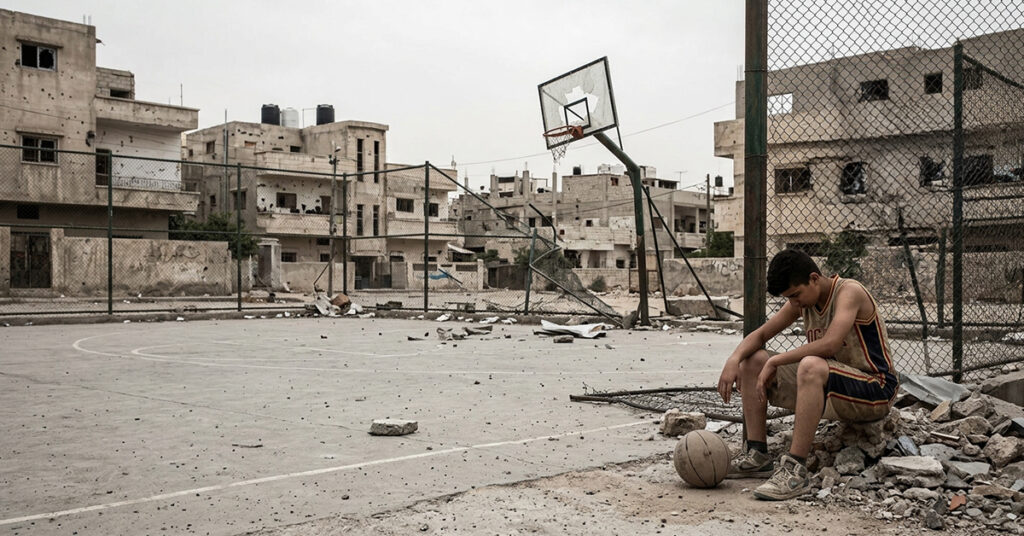
There was supposed to be a different story unfolding across Middle Eastern basketball this season.
It was supposed to be about growth. About packed gyms in Beirut. About Dubai’s bold entrance into the European club ecosystem. About Gulf basketball pushing for more relevance, more investment, more international legitimacy. About a sport that, for a moment, looked ready to stretch beyond its traditional boundaries and claim a bigger share of the global game.
Instead, the season has been shaped by war.
Across Israel, Lebanon, Dubai and the wider Gulf basketball landscape, the region’s professional game has been forced into a tense, unstable reality where schedules change, venues move, travel becomes a security question, and entire competitions are delayed by events far bigger than basketball. The games still matter. The rivalries still matter. The ambition is still there. But nothing feels fully normal.
The clearest example is in Israel, where top clubs have had to live a version of professional basketball that no serious league wants to normalize. On March 4, Euroleague Basketball announced that Maccabi Rapyd Tel Aviv would play its remaining home games in Belgrade, while Hapoel Tel Aviv would play in Sofia, because of the security situation in the region. For elite clubs, that is more than a scheduling inconvenience. It means “home” games without home crowds, home routines, or home-city energy. It means ticket revenue, sponsorship activation, and fan connection all get diluted at the exact moment clubs are trying to project stability.
That displacement changes basketball in ways standings alone cannot capture. A club without a true home court is not just losing noise in the building; it is losing the rhythm of its season. Players live more like travelers than residents. Families adjust to uncertainty. Coaches prepare for games in borrowed environments. And fans, the emotional foundation of any club sport, are pushed farther from the team. In a region where basketball identity is intensely local, that rupture matters. This is an inference drawn from the neutral-site decisions EuroLeague has now made for Israeli clubs.
The effects are not confined to Israel. They ripple outward across the region, which is why Dubai has become such an important part of this story. Dubai Basketball was built as a statement project: modern, ambitious, internationally minded, and designed to connect Middle Eastern capital and visibility to high-level club basketball. The club has been competing in the ABA League, and EuroLeague’s March 4 decision also moved Dubai Basketball’s remaining home games to Sarajevo. Even a project designed around expansion, glamour and infrastructure is not insulated from regional instability.
That irony says a lot about where Middle Eastern basketball stands. Dubai represents the future-facing version of the sport in the region: investment-heavy, globally branded, eager to sit at bigger tables. The United Arab Emirates has also already demonstrated its appetite for major basketball events, with Abu Dhabi hosting the 2025 EuroLeague Final Four at Etihad Arena. That was a landmark moment, signaling that the Gulf is not merely consuming elite basketball but trying to become one of its hosts and commercial partners. Yet even amid that momentum, the security situation has proved strong enough to push Dubai’s own club operations outside the UAE for home games.
Then there is Lebanon, where basketball has long meant more than entertainment. In Beirut and beyond, club basketball is civic identity, neighborhood pride, and emotional release. And this season, Lebanon has remained central to the regional map. FIBA announced the 2025-26 WASL-West Asia League schedule with the group phase opening in Beirutin November, and Lebanese clubs such as Al Riyadi and Sagesse have remained core actors in the competition. In February, Al Riyadi strengthened its push for the top seed with a win over Shahrdari Gorgan, while Sagesse earlier delivered a statement win over Al Riyadi in Ghazir. Even amid instability, Lebanese basketball has continued to produce high-level, high-stakes games.
But Lebanon’s centrality also makes it vulnerable. On March 2, FIBA said the schedules for both the WASL-Gulf Leagueand WASL-West Asia League were deferred due to the situation in the region. Around the same time, reports said FIBA also postponed World Cup qualifying games set for Lebanon and Qatar after U.S. strikes on Iran. So even where the basketball culture remains strong, the competitive calendar can be overtaken by geopolitics in an instant. For clubs, broadcasters and sponsors, that kind of uncertainty is corrosive. For players and fans, it becomes exhausting.
The Gulf leagues sit in a similarly uneasy position. On paper, this should be a period of consolidation and growth. FIBA’s WASL structure was designed to give clubs across West Asia and the Gulf a bigger, more coherent regional stage. The Gulf side of WASL had moved deep enough into its season that semifinal scheduling had already been publicized in February. Then, days later, the entire competition was deferred. That whiplash captures the fragility of the basketball economy in the region: one week the conversation is about knockout rounds and qualification paths, the next it is about whether games can proceed at all.
This is what war does to sport. It does not always shut the lights off completely. Sometimes it creates something harder to manage: a half-functioning ecosystem. Games happen, then don’t. Venues are approved, then shifted. Clubs sell ambition while quietly planning contingencies. Leagues publish calendars that everyone knows may not hold. In that environment, the business of basketball changes. Foreign players think differently about contracts. Agents think differently about placements. Sponsors think differently about risk. Fans learn not to trust that next week’s fixture will happen where it says it will. Those are reasonable conclusions from the postponed competitions and relocated home games now affecting multiple leagues.
And yet, the sport keeps insisting on itself.
That may be the most revealing part of the story. Lebanon still stages emotionally charged club games. Israeli teams still try to survive elite European competition from temporary homes abroad. Dubai still pushes its long-term basketball project forward. The Gulf leagues still try to maintain a regional structure worth building around. Even under pressure, no one seems willing to fully surrender the idea that basketball in the Middle East can become bigger, stronger and more globally connected.
But ambition is not the same as stability.
Right now, professional basketball in the Middle East is being asked to perform two jobs at once: to keep the sport alive in the present, and to protect belief in its future. In Israel, that means displaced clubs and fractured home-court identity. In Lebanon, it means carrying on in one of the region’s deepest basketball cultures while schedules remain vulnerable. In Dubai, it means proving a high-gloss expansion project can withstand regional shock. In the Gulf, it means preserving league credibility when fixtures can be delayed by events entirely outside the sport.
The games will continue. Some will be played in the wrong cities. Some will be postponed. Some will feel normal for two hours, until the wider world intrudes again.
That may be the defining truth of Middle Eastern basketball right now: the sport is still alive, still ambitious, still worth watching — but it is being played on unsteady ground.